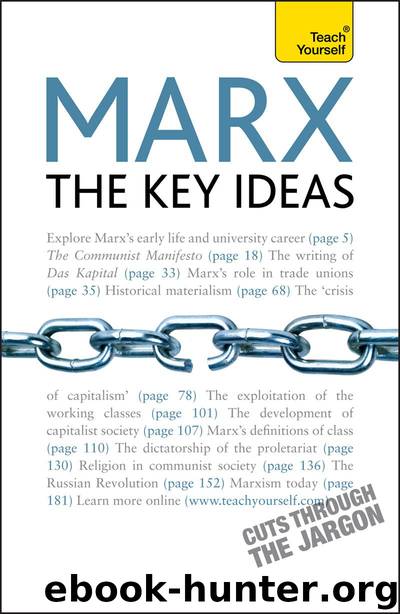
Marx - The Key Ideas: Teach Yourself (Teach Yourself General) by Hands Gill
Author:Hands, Gill [Hands, Gill]
Language: eng
Format: epub
ISBN: 9781444129571
Publisher: Hodder & Stoughton
Published: 2010-02-26T00:00:00+00:00
Exploitation
Alienation is connected to exploitation by the capitalist. Marx saw the exploitation of one class by another as a fundamental part of an industrialized capitalist society. Marx believed that there had always been exploitation but it was only under the capitalist system that exploiting others became the normal way of working. In Chapter 4 we saw that the capitalists hold the balance of power. They are able to make a profit from the surplus value because they own the means of production. The worker is not aware of the fact that he is being exploited. He believes the capitalist has a right to the surplus value that is produced because he believes that is just the way things are, or part of human nature. This kind of exploitation is not really visible, unlike the more common forms of exploitation such as making people work long hours, child labour and difficult and dangerous working practices and conditions.
In the introduction to Das Kapital Marx says that he has not painted a picture of capitalists and landlords in a ‘rosy light’. There are many examples of explicit exploitation of workers given as examples in the book. Chapter 10, The Working Day, consists of mountains of evidence that Marx collected from reports and newspaper articles. Evidence includes children working in mines and heavy industry in appalling conditions, engine drivers working 21-hour shifts, and dressmakers and milliners forced to work in overcrowded sweatshops where they died of consumption. Capital is ‘vampire like’, writes Marx in the introduction, and it ‘sucks living labour’.
In the Victorian era the average age for death among the working classes was just 19 years. Marx records descriptions of the physical state of many of the workers in British industrial cities in Das Kapital; many of the examining doctors report on the undernourished and progressively stunted growth of the working classes.
Marx believed that a shorter working day would greatly benefit those people and in most democratic countries today there are laws to regulate the hours that people have to work. The workers who had to fight for improvements in working conditions by uniting against the capitalists found their inspiration in the works of Marx.
Marx did not make overt moral judgements on the capitalists; he tried to distance himself from any moral commentary in his writing and tried to keep true to the idea of objective materialism. He saw Das Kapital as a scientific study. However, anyone who writes in such an emotive way as Marx does, comparing capitalists to ‘werewolves’ and ‘vampires’ (as he does in Das Kapital) is obviously not in favour of capitalism as a system and is making a moral statement. Marx applauded those who did their best to alleviate working conditions but he believed that both worker and capitalist alike are victims of the system. The capitalist is only a part of the society around him and has no choice but to continue with things the way they are, for even if a factory owner were to give away his goods and his factory somebody else would take his place.
Download
This site does not store any files on its server. We only index and link to content provided by other sites. Please contact the content providers to delete copyright contents if any and email us, we'll remove relevant links or contents immediately.
| Anarchism | Communism & Socialism |
| Conservatism & Liberalism | Democracy |
| Fascism | Libertarianism |
| Nationalism | Radicalism |
| Utopian |
The Secret History by Donna Tartt(19103)
The Social Justice Warrior Handbook by Lisa De Pasquale(12197)
Thirteen Reasons Why by Jay Asher(8919)
This Is How You Lose Her by Junot Diaz(6894)
Weapons of Math Destruction by Cathy O'Neil(6284)
Zero to One by Peter Thiel(5808)
Beartown by Fredrik Backman(5767)
The Myth of the Strong Leader by Archie Brown(5513)
The Fire Next Time by James Baldwin(5454)
How Democracies Die by Steven Levitsky & Daniel Ziblatt(5225)
Promise Me, Dad by Joe Biden(5157)
Stone's Rules by Roger Stone(5091)
A Higher Loyalty: Truth, Lies, and Leadership by James Comey(4966)
100 Deadly Skills by Clint Emerson(4931)
Rise and Kill First by Ronen Bergman(4797)
Secrecy World by Jake Bernstein(4756)
The David Icke Guide to the Global Conspiracy (and how to end it) by David Icke(4723)
The Farm by Tom Rob Smith(4517)
The Doomsday Machine by Daniel Ellsberg(4493)
